

Understanding Chicago's Affordable Requirements Ordinance
ARO units Chicago are income-restricted apartments created through the city's Affordable Requirements Ordinance, which requires developers of certain residential projects to set aside a percentage of units for qualifying households earning at or below Area Median Income (AMI) thresholds.
Quick Facts About ARO Units in Chicago:
- Income Limits: Generally for households at 60% AMI
- Availability: 10-20% of units in qualifying developments, depending on neighborhood zone
- How to Find Them: Use the interactive ARO Buildings Map or contact property managers directly
- Application: Through property management companies, not the City of Chicago
- Designation Period: Units remain income-restricted for 30 years
Chicago's Affordable Requirements Ordinance divides the city into four distinct zones—Downtown, Community Preservation, Inclusionary Housing, and Low-Moderate Income areas—each with different requirements for developers.
The program emerged from the city's mission to push back against longstanding patterns of segregation and exclusion by using inclusionary zoning. This means that when developers build market-rate residential projects and receive City Council approval, land sales, or financial assistance, they must include units for income-qualified residents.
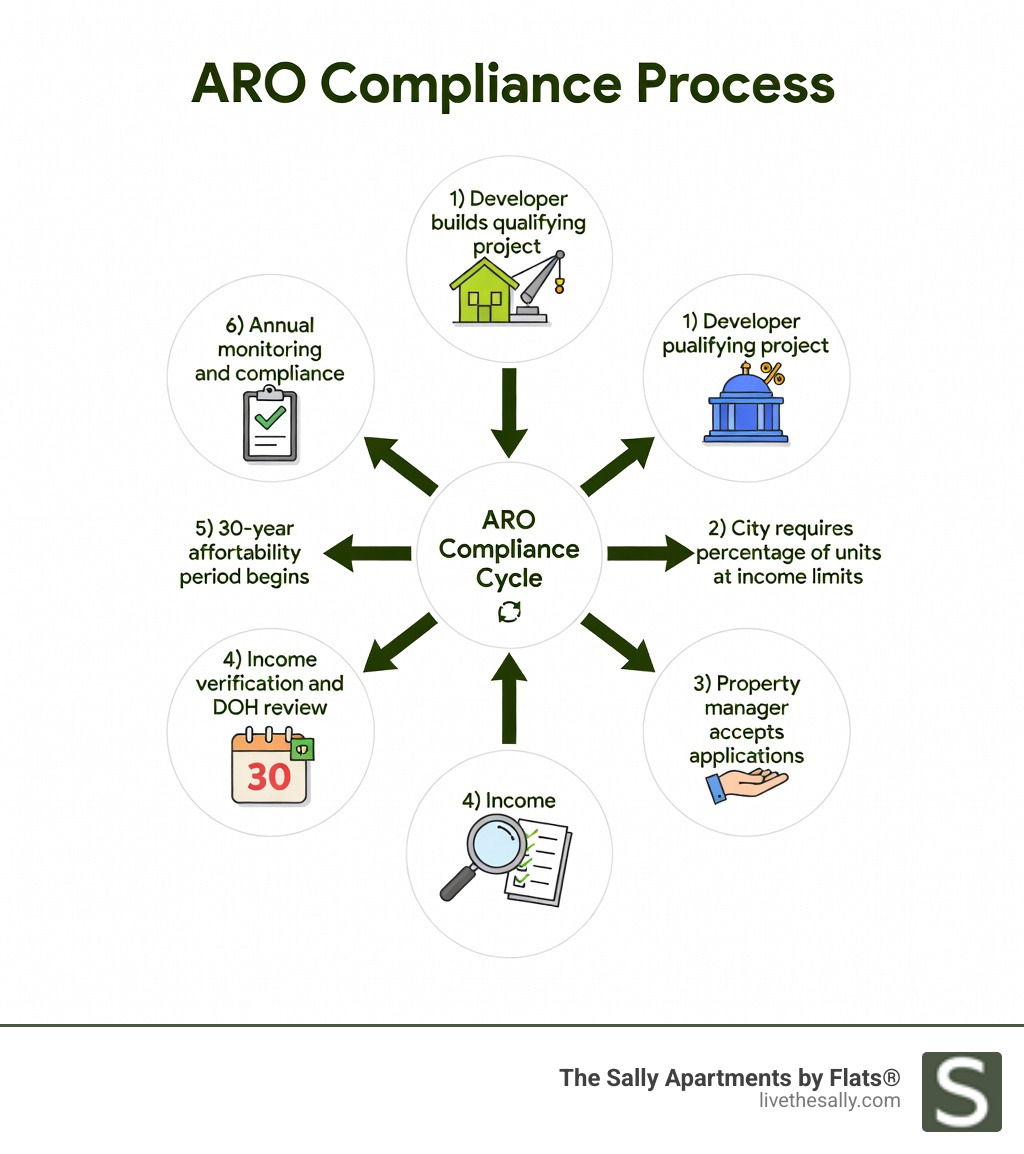
The Department of Housing oversees the program but does not own, operate, or manage ARO units. Instead, property managers at each building handle applications, verify income through employer and financial documents, and assess eligibility. Once approved, residents sign a Tenant Income Certification form, which then goes to the Department of Housing for secondary review within 10 business days.
A Comprehensive Guide to ARO Units Chicago
Navigating the landscape of aro units chicago requires understanding how the city's residential developments are regulated. The Affordable Requirements Ordinance (ARO) is a local law that harnesses private investment to create housing opportunities in market-rate developments. Originally established to combat urban segregation, the ordinance has evolved significantly, with the most recent major update being the 2021 ARO.
Under the current View Chicago ARO guidelines, residential developments that receive City Council approval for an entitlement (like a zoning change), a city land sale, or financial assistance after October 1, 2021, are subject to Chapter 2-44-085 of the Municipal Code. The Department of Housing (DOH) is the primary authority responsible for drafting the rules and monitoring compliance, ensuring that these units remain available to qualified residents for a 30-year period.
Program Zones and Requirements
The city is divided into specific zones, and the percentage of required units varies based on where the building is located:
- Low-Moderate Income Areas: Developers must set aside 10% of dwelling units.
- Community Preservation, Inclusionary Housing, and Downtown Districts: Developers must set aside 20% of dwelling units.
- Fulton Market Innovation District (FMID): In the area north of Lake Street, there is a specialized 30% goal for new residential projects.
In many of these areas, particularly downtown and in community preservation zones, at least half of the required units (which equates to 25% of the total requirement) must be built on-site. This ensures that new residents have direct access to the same neighborhoods and building amenities as market-rate tenants.
Eligibility and Income Limits for Program Participation
To live in aro units chicago, a household must meet specific income criteria based on the Area Median Income (AMI). These limits are updated annually by the city to reflect the current economic climate of the Chicago metropolitan area.
The standard benchmark for most rental ARO units is 60% AMI. This means the total gross income for everyone living in the apartment cannot exceed a certain dollar amount.
| Household Size | 60% AMI Income Limit (Example) |
|---|---|
| 1 Person | $50,400 |
| 2 People | $57,600 |
| 3 People | $64,800 |
| 4 People | $71,940 |
| 5 People | $77,700 |
| 6 People | $83,460 |
For more details on how these limits apply to specific floorplans, you can More info about ARO plans.
Eligibility for ARO Units Chicago
Beyond just the raw numbers on a W-2, there are several layers to the eligibility process:
- Income Certification: Property managers will conduct a thorough review of your financial history. This includes verifying all sources of income, such as wages, social security, child support, and even interest from savings accounts.
- Asset Limits: While the program primarily focuses on annual income, there are often limits on total household assets to ensure the units are serving the intended population.
- Occupancy Standards: The size of the apartment must be appropriate for the number of people in the household. For example, a single person may not be eligible for a three-bedroom unit unless there are specific circumstances.
- Annual Recertification: Eligibility isn't a "one and done" deal. Residents must typically recertify their income every year to ensure they still meet the program's requirements.
How to Locate and Apply for Program Housing
Finding aro units chicago requires a bit of detective work, as the City of Chicago does not maintain a centralized "vacancies" list. Instead, the inventory is spread across hundreds of privately managed buildings throughout the city.
The first and most important tool in your search is the ARO Map. This interactive map allows you to see every building in the city that contains ARO units. By clicking on a data point, you can find the property's address, the types of units available (studios, one-bedrooms, etc.), the AMI level they serve, and—most importantly—the contact information for the leasing office.
How to Search for ARO Units Chicago
Because these units are highly sought after, they are often filled on a first-come, first-served basis. Here is how we recommend approaching your search:
- Interactive Maps: Use the ArcGIS-based "ARO Rental Buildings" map to filter by neighborhood.
- Direct Inquiry: Once you identify a building you like, such as those offering a Floorplan A1 ARO, call the leasing office immediately. Ask specifically about the "ARO waitlist" or current ARO availability.
- Waitlist Management: Many popular buildings stay 100% occupied. Ask to be placed on their internal notification list so you are the first to know when a unit becomes available.
The Application Process for ARO Units Chicago
The application process is more rigorous than a standard market-rate lease. You will need to provide extensive documentation, including:
- The last 4–6 consecutive paystubs.
- The most recent 2–6 months of bank statements for all accounts.
- Employment verification forms signed by your employer.
- Social Security or pension award letters (if applicable).
- A Self-Employment Affidavit if you work for yourself.
Once the property manager reviews your file and determines you are eligible, you will sign a Tenant Income Certification (TIC). This document is then submitted to the DOH. The DOH has 10 business days to issue a final approval or denial. If denied, you have the right to submit a written appeal within 10 business days of the notice. For a look at available layouts, check out Floorplan C15 ARO.
Design Standards and Amenities in Program Developments
One of the best aspects of the aro units chicago program is the "comparability" rule. The city requires that ARO-designated units be functionally equivalent to market-rate units in the same building. This means residents aren't tucked away in a dark corner of the basement; developers must distribute these units across at least one-third of the floors in a high-rise.
Construction and Finish Standards
According to the DOH's architectural design standards, ARO units must meet high-quality benchmarks:
- Comparable Finishes: The flooring, countertops, and cabinetry should match or closely resemble what is found in market-rate units.
- Square Footage: While ARO units can be slightly smaller, they must be within 15% of the average size of market-rate units of the same type. For example, a Floorplan A2 ARO is designed to be spacious and efficient.
- Energy Efficiency: All appliances must be new and Energy Star compliant.
- Major Systems: For off-site or rehabbed units, major systems like HVAC, plumbing, and electrical must be new or recently replaced.
Building Amenities
When you live in an ARO unit, you typically get full access to the building's luxury amenities. This is a huge perk of urban living in Chicago! At The Sally Apartments by FLATS, residents enjoy:
- Rooftop Access: Take in the Chicago skyline from the expansive rooftop terrace.
- Fitness Centers: Skip the gym membership and use the on-site fitness facilities.
- In-Unit Laundry: Modern convenience is a standard, not an upgrade.
- Pet-Friendly Facilities: The buildings feature a dedicated dog run and a pet spa for easy grooming. Please note that there is a two-pet maximum per apartment to ensure a comfortable environment for everyone.
Frequently Asked Questions About ARO Units Chicago
What is the difference between on-site and off-site units?
On-site units are located within the same building as the market-rate apartments. Off-site units are located in a different building, usually within the same neighborhood zone. The city has strict "Minimum Standards for Off-Site Residential Units" to ensure these apartments are just as high-quality as those built on-site, including requirements for soundproofing, security systems, and exterior landscaping.
How long is the compliance period for these units?
The income-restriction period for aro units chicago is 30 years. This applies to both rental and owner-occupied units. The Department of Housing monitors these properties annually to ensure they are being leased to qualified households at the correct rent levels.
Are program units available for purchase?
Yes, though they are less common than rentals. Owner-occupied ARO units are administered by the Chicago Housing Trust. These homes are typically designated for households earning between 80% and 100% of the AMI, though households earning up to 120% AMI may sometimes be eligible. These units also come with a 30-year deed restriction to ensure they stay within the program if they are resold.
Conclusion
The aro units chicago program is a vital part of creating inclusive communities in our city. It allows residents from various backgrounds to live in high-growth neighborhoods with access to transit, employment, and world-class culture.
At The Sally Apartments by FLATS, modern rentals are available in the heart of Uptown Chicago. The community features in-unit laundry, a rooftop terrace, and pet-friendly amenities including a dog run and a pet spa. Please note there is a two-pet maximum per apartment.
To explore layouts, visit View available ARO plans and learn more about current options.